
By Xpert Packages Team · · Updated
Folding Carton Box Styles: Tuck End, Auto-Lock, Seal End and When to Use Each
What is a folding carton?
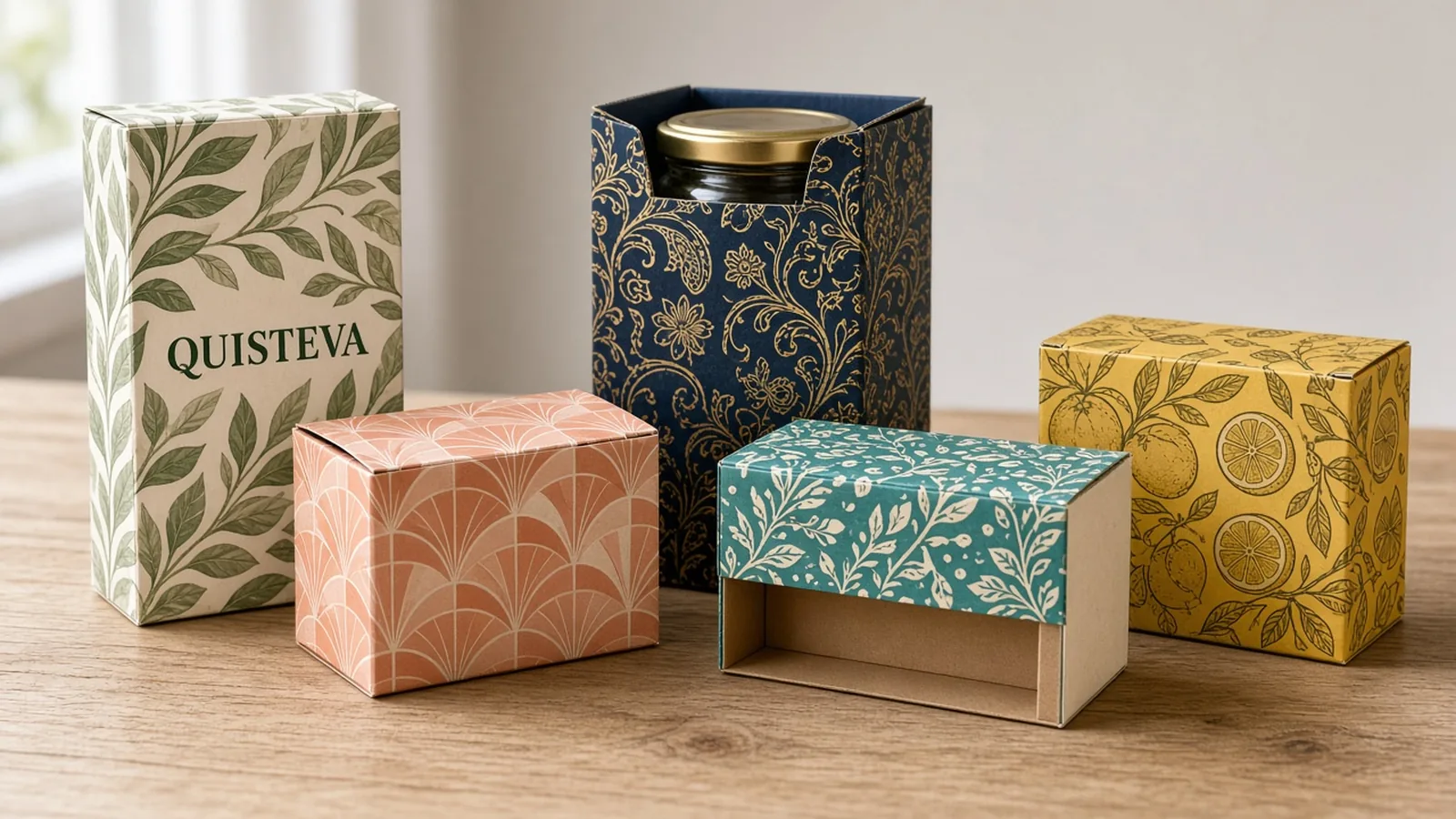
A folding carton is a printed paperboard box that is made to your exact size, ships flat, and is folded into shape when you pack. Our folding cartons are printed paperboard cartons for retail products, made to your size, board and finish. They are the everyday retail carton: light, crisp, and built for the shelf rather than for shipping a product on its own.
That is the main difference from a rigid or magnetic box, which is set up before it ships and is quoted individually. If you are still choosing between those families, start with rigid boxes vs folding cartons. This guide stays inside the folding-carton family and compares the styles on that category page: how each one closes, when to use it, and the starting price shown on its product page.
Every box is made to your exact size, with no size limit and no standard sizes. Options commonly listed on these product pages include offset or digital printing, foil and spot UV, with other finishes confirmed on your quote.
What are the main folding carton styles?
These are the folding carton products currently in our catalog, with the closing style and starting price taken from each live product page:
| Style | How it closes | Starting price |
|---|---|---|
| Tuck end boxes | The everyday retail carton for light products, with tucked ends | From $0.53 / unit at 1,000 units |
| Reverse tuck boxes | Top and bottom tucks close from opposite sides | From $0.53 / unit at 1,000 units |
| Straight tuck boxes | Top and bottom tucks close from the same side | From $0.59 / unit at 1,000 units |
| Auto-lock bottom boxes | The base locks when the carton is squared, without tape | From $0.59 / unit at 1,000 units |
| Seal end boxes | Glued end flaps, sealed after filling | From $0.59 / unit at 1,000 units |
| Product boxes | A general-purpose printed retail box for a single product | From $0.53 / unit at 1,000 units |
| Sleeve packaging | A printed sleeve that wraps around a tray or box | From $0.39 / unit at 1,000 units |
Starting prices are estimated prices per unit, not a quote. Final price depends on specifications and quantity, and runs of 50–249 are quoted individually. The style you pick should follow how the product is packed and how the customer opens the box, not the starting price alone.
When should I use a tuck end or reverse tuck box?
Tuck end boxes are tuck-end folding cartons, the everyday retail carton for light products. For small, lightweight items that sit on a shelf or go inside an outer shipper, this is the dependable default. The ends tuck closed by hand, so packing does not need glue or tape at the top or bottom, and the carton can be opened and closed again if needed.
Reverse tuck boxes are folding cartons whose top and bottom tucks close from opposite sides, a common retail carton style. That opposite-side close leaves a clean, uninterrupted front panel, which is why cosmetics, personal care items and other lightweight retail products often use this style. If the front face carries the main artwork, a reverse tuck keeps the opening out of that panel.
Straight tuck boxes are folding cartons whose top and bottom tucks close from the same side for a clean front-panel opening. Need a retail carton that opens from the front? This is the style built for that motion, and it suits cosmetic, wellness and other retail products where the customer expects to lift a tuck on the same face as the opening. Straight tuck is a separate catalog style from our everyday tuck end carton, with its own product page and starting price.
All three tuck styles are a good fit when the product is light, the pack-out is done by hand, and you want a carton that ships flat and erects without glue at the ends. If the product is heavier, or the line seals cartons after filling, look at auto-lock or seal end instead.
When is an auto-lock or seal end carton the better choice?
Auto-lock bottom boxes are folding cartons with automatic or snap-lock bottoms, also called a crash-lock bottom. The base locks when the carton is squared, without tape. That one-move bottom is useful when you are packing a heavier retail item and want the carton to stand on a locked base before the product goes in. These are not rigid boxes and not mailers: they are still a folding carton, and they still ship flat.
Seal end boxes are folding cartons with glued end flaps, suited to products packed and sealed in larger runs. Food, household and other packaged goods that are sealed after filling need a carton built for that step. The ends are glued closed rather than tucked, so this style suits a packing line that fills and seals, rather than a hand-tucked retail pack that customers may reopen.
| If you need to… | Start with |
|---|---|
| Pack a light retail product by hand | Tuck end, reverse tuck or straight tuck |
| Keep a clean, uninterrupted front panel | Reverse tuck |
| Open the carton from the front panel | Straight tuck |
| Lock a sturdy base without tape as you square the carton | Auto-lock bottom |
| Glue the ends after filling, including on a packing line | Seal end |
If both an auto-lock and a seal end carton could work, tell us how the product is filled and whether the customer should be able to reopen the box. That packing detail is enough to choose between a locked-then-tucked carton and a glued seal-end carton.
Where do product boxes and sleeves fit in?
Product boxes are general-purpose printed retail boxes for presenting and selling a single product. If you need one printed box to present and sell a single item, this is the place to start. They work for retail shelves, eCommerce cartons and launches across a product line, and they sit among our folding carton styles alongside the more specific tuck, auto-lock and seal-end structures. When you already know you need a particular close, go straight to that style; when you only know you need a printed retail box for one product, start here.
Sleeve packaging is a printed sleeve that wraps around a tray or box to add branding without a full printed box. A sleeve slides over your existing pack, which makes it a practical way to brand a plain tray or to dress a standard box for a seasonal or limited edition. The sleeve is the printed surface; the tray or inner box is specified separately on your quote.
Sleeves are still a folding carton style, and they ship flat like the rest of the family. They are not a substitute for a mailer or a shipping carton: a sleeved pack that has to travel on its own still needs an outer box. For the wider set of box types, including mailers and shippers, see types of packaging boxes.
How much do folding carton styles cost?
Each product page shows an estimated starting price and a quantity table. These are the estimates currently shown, copied from the live pages:
| Style | 250 | 500 | 1,000 | 2,500 | 5,000 |
|---|---|---|---|---|---|
| Tuck end, reverse tuck, and product boxes | $1.26 | $0.78 | $0.53 | $0.37 | $0.30 |
| Straight tuck, auto-lock bottom, and seal end | $1.12 | $0.86 | $0.59 | $0.56 | $0.52 |
| Sleeve packaging | $0.74 | $0.57 | $0.39 | $0.37 | $0.34 |
Estimated price per unit, not a quote. Your written quote is based on your exact specifications and includes setup, die, plate and US shipping. Quantity rows for 50–249 show Quote on request. Price depends on dimensions, material, structure, printing, number of colors, finishes, inserts, quantity, and production and shipping requirements. Final price depends on specifications and quantity.
How do I choose a folding carton style and order?
Start with how the product is packed and how the box should open, then confirm the style on your quote:
- Measure the product at its widest points, including caps, pumps or lids, and share length × width × height.
- Decide whether the carton is filled by hand or sealed on a line.
- Choose a tucked end for a hand-packed light product, an auto-lock bottom when you want the base to lock as you square the carton, or a seal end when the flaps will be glued after filling.
- If you only need a wrap of print around an existing tray or box, specify a sleeve.
- Tell us the board look you want, plus print and finish, so those options can be confirmed on your quote.
Our minimum order is 50 units, and runs of 50–249 are quoted individually. Before production we provide a digital proof, such as a dieline or 3D preview with your artwork, where technically supported. Production typically takes 7–14 business days after proof approval. Rush production in 5 business days for 25% extra. Shipping time varies by destination.
When you are ready, Get a Custom Quote or Get a Quick Quote. Send the style, the product dimensions, the quantity and any print or finish notes, and our sales team will reply with a written quote.
Frequently asked questions
- What is the difference between a straight tuck and a reverse tuck box?
- On a straight tuck box, the top and bottom tucks close from the same side, which gives a clean front-panel opening. On a reverse tuck box, the top and bottom tucks close from opposite sides, which leaves a clean, uninterrupted front panel. Both are folding cartons for lightweight retail products.
- What is an auto-lock or crash-lock bottom box?
- An auto-lock bottom box is a folding carton whose base locks when the carton is squared, without tape. It is also called a crash-lock or snap-lock bottom. It is not a rigid box and not a mailer, and it still ships flat.
- When should I use a seal end carton?
- Use a seal end carton when the product is packed and the end flaps are glued closed, including on larger runs. This style suits food, household and other packaged goods that are sealed after filling, rather than tucked by hand.
- Do folding cartons ship flat?
- Yes. Folding cartons ship flat and are folded into shape when you pack. Rigid and magnetic boxes ship set up and are quoted individually.
- What is the minimum order for folding carton styles?
- Our minimum order is 50 units, and runs of 50–249 are quoted individually. Each product page also shows Minimum order: 50 units.
- How much do custom folding cartons cost?
- Tuck end, reverse tuck and product boxes show From $0.53 / unit at 1,000 units. Straight tuck, auto-lock bottom and seal end boxes show From $0.59 / unit at 1,000 units. Sleeve packaging shows From $0.39 / unit at 1,000 units. These are estimated prices per unit, not a quote; final price depends on specifications and quantity.
About the author: Xpert Packages Team
Xpert Packages is a custom packaging solutions provider serving businesses across retail, eCommerce, food, cosmetics and other industries. Our team writes these guides from the box styles, materials and finishes in our own catalog.